 listicle
What website design tips convert hospitality visitors into bookings?
Last Updated: 25 October 2026
Quick Summary
Website design tips hospitality businesses need focus on removing friction from the booking journey through mobile-first layouts, transparent pricing, simplified checkout processes, and clear navigation. The difference between sites that fill rooms and those that generate abandoned browsing sessions comes down to deliberate design choices that build guest confidence and guide visitors toward completing bookings.
- More than half of hotel bookings now start on a mobile device, making mobile-friendly design essential rather than optional.
- Display availability calendars with sold-out dates in grey and available dates in green to help guests scan inventory in 10 seconds.
- Show nightly rates, total stay costs, taxes, and service charges upfront to build trust and prevent abandonment at checkout.
- Place your main navigation menu at the top of every page with Book Now as a primary option, not buried in submenus.
Table of Contents
- Why website design tips matter for hospitality businesses
- Mobile-friendly hospitality website design
- Hotel website booking features that drive conversions
- Hospitality website best practices for navigation and layout
- Hospitality website examples that work
- Common website design mistakes hospitality businesses make
- Getting your hospitality website designed and built
- Frequently Asked Questions
Why website design tips matter for hospitality businesses
A hotel or bed-and-breakfast website that doesn't convert visitors into bookings is costing you revenue every single day, which is why website design tips hospitality businesses need are essential to understand. The difference between a site that sits idle and one that fills rooms comes down to deliberate design choices, not luck or budget. At ITWizrd, we specialise in crafting bespoke, high-conversion professional websites designed specifically for small businesses across Glasgow, Paisley, and the wider UK, including hospitality businesses.
The challenge most hospitality owners face is straightforward: you get decent traffic, but visitors aren't completing bookings. They're browsing your rooms, checking your rates, then disappearing to a competitor's site. Website design tips for hospitality businesses address exactly this problem. They're not about making your site look pretty, they're about removing friction at every step of the booking journey.
A framework for evaluating hospitality website effectiveness, developed through research and expert interviews, reveals that successful sites share common structural patterns. These patterns aren't optional niceties; they're the mechanics that separate sites that book rooms from sites that generate abandoned browsing sessions.
Mobile-friendly hospitality website design
More than half of hotel bookings now start on a mobile device. If your website design tips don't prioritise mobile-first layout, you're losing bookings to competitors with responsive designs. Mobile-friendly hospitality website design isn't an upgrade, it's the foundation.
A mobile-friendly site means your navigation is accessible with a thumb. Your booking button appears above the fold. Your room images load quickly even on slower connections. Your contact information is clickable, not buried in footer text that requires zooming.
The specifics matter. Text should be readable at 14px or larger without pinching. Buttons need to be at least 44 pixels tall so they're easy to tap. Forms should ask for the minimum information required, asking for a phone number, email, and booking dates is friction; asking for shoe size is sabotage.
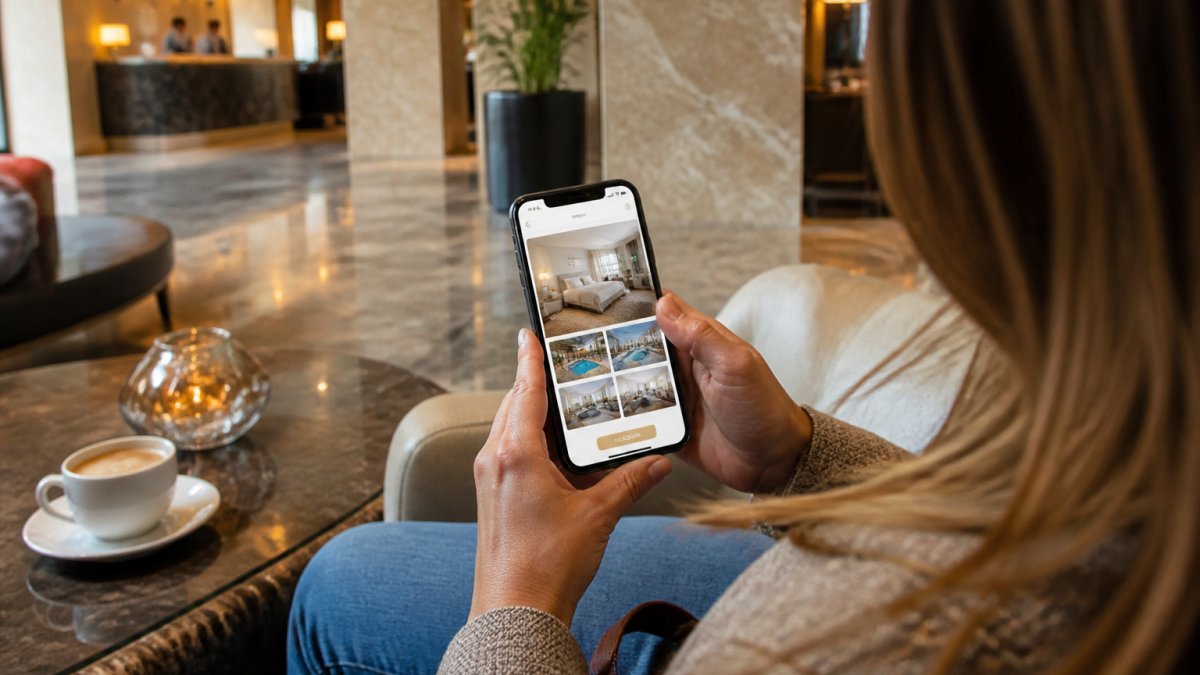
Test your site yourself. Open it on your phone. Try booking a room one-handed. If you're scrolling horizontally, your site isn't mobile-friendly. If buttons are hard to tap, visitors will abandon the process. This is where most hospitality websites fail, they look fine on desktop, then collapse on mobile.
Hotel website booking features that drive conversions
Your booking engine is the heart of your website design tips hospitality strategy. Every feature either removes friction or adds it. Successful hotel website booking features share a few critical elements.
First, show availability clearly. Don't make guests guess whether rooms are available on their preferred dates. Display a calendar that shows which dates have inventory. Highlight sold-out dates in grey.
Second, display pricing upfront. Hidden fees kill conversions. Show the nightly rate, the total for their stay, and any taxes or service charges.
Third, simplify the checkout process. Every form field you add increases abandonment. Ask for name, email, phone, and payment details. That's it.
Fourth, add trust signals. Display your star rating if you have one. Show recent guest reviews. Include your cancellation policy in plain language. If you offer a money-back guarantee, state it.
guidance on hotel website design best practices emphasises that direct bookings require clear pricing and transparent policies to compete with third-party booking platforms.
Consider offering a live chat option for guests with questions. Many bookings fail because a guest has a question, about pet policies, accessibility, parking, and can't find the answer.
Internal link: Learn how conversion optimisation tools and methods can improve your booking features with our analysis of CRO approaches for hospitality sites.
Successful booking engines share four critical elements that remove friction and build guest confidence.
| Feature | Purpose | Implementation |
|---|---|---|
| Availability calendar | Show which dates have inventory | Highlight sold-out dates in grey, available dates in green |
| Transparent pricing | Display total cost upfront | Show nightly rate, total stay cost, taxes, and service charges |
| Simplified checkout | Reduce form abandonment | Ask only for name, email, phone, and payment details |
| Trust signals | Reassure guests of legitimacy | Display star rating, guest reviews, cancellation policy, guarantees |
Hospitality website best practices for navigation and layout
Your website's structure determines whether guests find what they need or bounce in frustration. Hospitality website best practices start with clear navigation.
The main navigation menu should appear at the top of every page. It should include: Home, Rooms, Amenities, Location, Contact, and Book Now. Don't bury booking behind a submenu, make it a primary option. Guests shouldn't have to hunt for the booking button.
Use a hero image that shows your property or your best room.
Organise room information consistently. Show each room type with a photo, description, amenities list, and price. Let guests filter by price or room size. If you have a suite, a double room, and a single room, make it obvious which is which and how they differ.
Place your contact information in the header and footer. Phone number, email, address, make it easy to find. Many guests prefer to call rather than book online. Don't force them to dig through your site to find your number.
best practices for clear page hierarchy and navigation recommends placing your main navigation at the top and using a clear visual hierarchy to guide guests toward conversion actions.
Hospitality website examples that work
Real examples illustrate what effective hospitality website design tips look like in practice.
Independent hotels that convert well share a pattern: they lead with their unique selling point. A boutique hotel might highlight its design aesthetic and local location. A countryside inn might emphasise peace and nature. A city business hotel might stress proximity to transport and conference facilities.
These sites use high-quality photography. A blurry photo of a room costs you bookings. Professional photography of your actual rooms, your restaurant, your lobby, these build confidence that guests will get what they see. Stock photos of generic hotel rooms feel impersonal and often backfire.
Successful hospitality websites also tell a story. Instead of just listing amenities, they explain what guests will experience. "Wake to views of the bay" beats "room has window." "Relax by our heated pool after exploring the city" beats "outdoor pool, heated." This narrative approach makes guests envision themselves at your property.
These sites also feature recent guest reviews prominently. Not just a star rating, but actual quotes from guests. "Best stay of our holiday" or "Staff made us feel so welcome" carry weight that your own marketing copy cannot.
Common website design mistakes hospitality businesses make
Most hospitality website failures stem from a few repeated errors. Understanding these mistakes helps you avoid them.
The first mistake is treating your website like a brochure instead of a booking engine. You spent money on photography and content, so you want to showcase it all.
The second mistake is poor image optimisation. Large, uncompressed photos look beautiful but load slowly. Slow sites lose bookings. Compress your images without losing quality. Serve mobile-sized images to mobile devices. Test your site's load speed.
The third mistake is unclear pricing. Guests hate surprises at checkout. If your nightly rate is £120 but taxes and fees add another £30, state that upfront. If breakfast is included, say so. If parking costs extra, display it.
The fourth mistake is a booking engine that doesn't work smoothly. If your booking system crashes, if it requires guests to create an account before checking availability, if it takes five minutes to complete a booking, you're losing sales.
The fifth mistake is outdated design. A website that looks like it was built in 2015 signals that your business might be neglected too. You don't need trendy design, but you need clean, modern, professional design.
hotel website design trends including mobile optimisation and personalisation highlights that speed, mobile experience, and personalisation are now essential, not optional, for hospitality websites.
Getting your hospitality website designed and built
When you're ready to invest in a proper hospitality website, you face a choice: custom design or template-based platforms like Wix or Squarespace.
Template platforms are fast and cheap. You can launch a site in days for a few hundred pounds. But templates limit what you can do. Your booking engine is basic. Your design looks similar to hundreds of other hotels.
Custom design costs more and takes longer, but it's built specifically for your business. Your booking engine works the way your business works. Your design reflects your brand. You own the code, not a platform.
Internal link: Explore the differences between custom design and template platforms when commissioning your hospitality website.
ITWizrd specialises in bespoke web design for small businesses, including hospitality businesses. We build sites that convert visitors into bookings.
Internal link: Learn whether investing in high-conversion design is worth the cost for your hospitality business with our analysis of conversion-focused design investment.
The investment in a proper website pays for itself through increased direct bookings. Every booking you capture directly is revenue you keep, no commission to third-party platforms, no margin taken by booking sites.
guidance on selecting a website design agency for hospitality businesses emphasises that specialist hospitality agencies understand guest experience in ways generic web shops do not.
If your hospitality website isn't converting visitors into bookings, the problem isn't traffic, it's design. We handle the mobile experience, the booking flow, the trust signals, and the conversion optimisation. Bespoke web design for small businesses in your area, built to convert visitors into calls, enquiries, and customers.
Frequently Asked Questions
What should a hospitality website include to encourage bookings?
A high-converting hospitality website needs a clear hero section with a prominent call-to-action, fast-loading booking system, high-quality photography of rooms or dining areas, guest reviews and ratings, transparent pricing, contact details, and mobile optimisation. The booking process should be visible above the fold and require minimal steps. Include information about your unique selling points, amenities, location and house rules. A fast, mobile-friendly site with these elements significantly improves conversion rates.
How do hotel website booking features improve direct bookings?
Hotel website booking features that work include real-time availability calendars, instant confirmation, multiple payment options, and a streamlined checkout process requiring only essential information. Allowing guests to select specific rooms, view photos, and see exact pricing before committing reduces abandonment. Offering flexible cancellation policies and displaying them clearly builds trust. Integration with your property management system ensures accuracy. A booking engine that works seamlessly on mobile devices is critical, as most hospitality searches happen on phones.
Why is a mobile-friendly hospitality website essential?
Most hospitality searches and bookings now happen on mobile devices. A mobile-friendly hospitality website loads quickly, displays content clearly on small screens, and makes booking simple with large touch targets and minimal scrolling. Poor mobile experience drives visitors to competitors. Mobile optimisation affects search rankings too; Google prioritises mobile-responsive sites. For hospitality, mobile performance directly impacts conversion rates and revenue, making it non-negotiable.
What makes a good restaurant or hotel website design?
Good hospitality website design combines clear visual hierarchy, professional photography, fast loading times, and intuitive navigation. The homepage should immediately communicate what you offer and how to book or contact you. Use consistent branding, readable fonts, and sufficient contrast. Include authentic guest reviews, clear pricing, and a prominent reservation or contact system. Mobile responsiveness is essential. Avoid cluttered layouts, auto-playing videos, or excessive animations that slow the site. Design should reflect your brand personality while prioritising user experience and conversions.
How can I improve user experience on a hospitality website?
Improve hospitality website user experience by reducing page load times, simplifying navigation to three levels maximum, placing key information above the fold, and using clear headings and short paragraphs. Ensure your booking system is intuitive and visible on every page. Include high-quality images, guest testimonials, and FAQs to answer common questions. Test the site on multiple devices and browsers. Use analytics to identify where visitors drop off, then fix those pages. Regularly update content, especially availability and pricing, to maintain trust.